

The state-owned company will face 16 negotiations and the private mining company three. The biggest test is expected to involve the latter and Escondida’s Union No. 1.
Although some collective bargaining negotiations remain in the mining sector this year, the calendar for 2027 is already taking shape. While it includes fewer negotiations, major players will be involved.
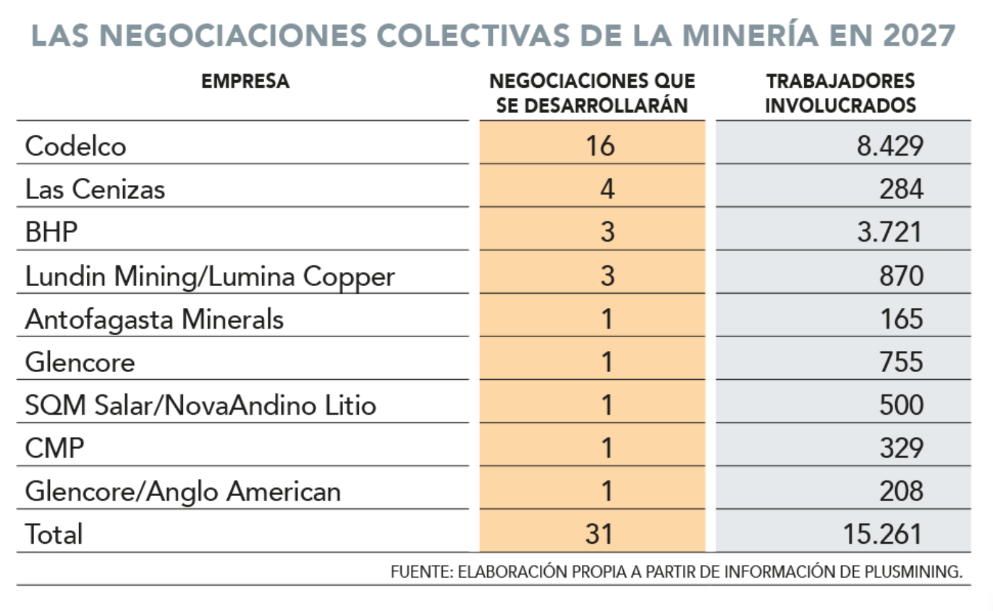
According to data compiled by consultancy Plusmining, 31 collective bargaining negotiations are expected in 2027, compared with 44 in 2026.
In 2027, Codelco will face 16 negotiations involving more than 8,429 workers, while BHP will have three involving 3,721 workers. The private mining company, however, faces the most complex test: agreeing on a new collective agreement with Minera Escondida’s Workers’ Union No. 1.
Fiorella Ulloa, Head of Political and Regulatory Affairs at Plusmining, warns that some negotiations in 2027 will be particularly significant. “El Teniente will require special attention because of the accidents and operational difficulties it has faced. This could give greater weight to safety and working conditions in the negotiations, at a time when Codelco needs to restore production and improve its operational performance,” she says.
She adds that Escondida’s negotiations will stand out because of the size of its unions, their history of industrial action and the operation’s importance within the industry: “Although its production and economic conditions mean its agreements cannot be extrapolated to other operations, the results of its negotiations tend to raise expectations among other unions.”
Ulloa believes that “high copper prices and the benefits agreed in 2026 may raise union expectations.” At the same time, “production difficulties and cost pressures, particularly at Codelco, maintain the need to improve productivity and safeguard operational continuity. Demanding negotiations are therefore expected, with their complexity depending on each operation’s economic, operational and labor circumstances.”
Codelco says collective bargaining is part of an ongoing relationship it builds with its unions: “This is the foundation on which we are approaching the new bargaining cycle, which runs from the second half of this year through August 2028.”
The company emphasizes that “our priority is to maintain effective channels of dialogue and conduct responsible negotiations that reconcile workers’ expectations with Codelco’s operational and sustainability challenges.”
The most complex negotiation
One of the final collective bargaining negotiations remaining this year is between BHP and the Spence Supervisors’ Union. With the contract due to expire on November 30, the organization—which represents 462 members—submitted its proposal to the company on October 14 and was therefore due to receive a response on October 26.
According to union President Juan Ovalle, the current demands focus on improving transportation arrangements and work flexibility, as the union is now composed mostly of young people who live in Santiago and must travel to work.
The union concluded its previous negotiation with a CLP 19.6 million package and is seeking a market-aligned bonus of between CLP 25 million and CLP 27 million in the current process.
One of the negotiations drawing the most attention involves Escondida’s Workers’ Union No. 1, which represents 2,200 workers. Its current contract expires on August 1, 2027. Workers are expected to submit their proposal in the first weeks of June, and the company should present its final offer around July 25.
“We will conduct this process taking into account all the gaps that have become apparent during the current safety crisis in mining, and the company’s duty to ensure safe working conditions for all workers,” says union President Sebastián Liberona. He adds that they are organizing to pursue some form of framework agreement for contractors.
Liberona warns that the company has typically concentrated bargaining efforts in the mediation stage, something he says they will not allow. In fact, he believes “the process will be tough,” making a strike highly likely.
BHP says statutory collective bargaining processes are highly significant and that current negotiations are taking place in a particular industry context, strongly shaped by declining production, low ore grades, difficulty accessing ore and cost pressures.
The latest quarterly results released this week demonstrate precisely that: at Group level alone, BHP’s copper production fell by 19%,” the company said. It added: “As a company, the fundamental priority is to approach every collective bargaining process by considering how to ensure, together with workers, the long-term sustainability of our operations, so that we can navigate difficult production conditions.”
Looking ahead to the upcoming negotiations, the mining company emphasized that “as a company, we always approach every negotiation, regardless of the union involved, with respect for freedom of association and Chilean law. Next year’s processes are statutory negotiations, so we expect them to be conducted in accordance with the regulations and to involve constructive dialogue, considering the difficult production conditions the company is experiencing.”
Source: Diario Financiero