

Chile and Kazakhstan will be the only countries worldwide to record a production decline this year. Their competitors, the Democratic Republic of the Congo and Peru, will grow.
The negative figures for domestic copper production have upended the government’s economic expectations, which have had to be revised downward quarter after quarter in line with a mining sector that will not recover in 2026.
This year will mark a significant milestone in declining production, with figures not seen since 2003. In 2004, the country broke a historical pattern by crossing the threshold of 5 million tonnes of copper, reaching a total of 5.4 million. In preceding years, several mining projects had begun operating, while others already in production expanded their capacity, increasing Chile’s copper output.
For example, 2004 was the first year that Escondida, the world’s largest copper mine, exceeded one million tonnes, reaching 1.1 million. At the time, Collahuasi was already producing around 400,000 tonnes, while Chuquicamata was delivering more than 600,000 tonnes.
Meanwhile, production in 2003 totaled 4.9 million tonnes, a figure similar to that expected this year. This makes 2026 a historic year, although not for positive reasons, as it will be the first time in 22 years that Chile falls below 5 million tonnes.
On Friday, the Chilean Copper Commission (Cochilco) projected copper production of 4.935 million tonnes for 2026 in its third quarterly copper trends report. This would represent an 8.4% decline, equivalent to exactly 453,000 fewer tonnes.
The report also states that production through September totaled 3.633 million tonnes of copper, down 8.5% from the same period last year, when 3.972 million tonnes were produced. As a result, output over these nine months was 339,000 tonnes lower.
For 2027, Cochilco forecasts production of 5.084 million tonnes, which would represent a 3% increase over 2026. The agency’s forecasts show Chile’s weakening position globally. Among the major producing nations,
The Democratic Republic of the Congo (DRC), the world’s second-largest copper producer, will grow by 6.5% to 3.629 million tonnes this year. Peru, the third-largest, will increase production by 0.5% to 2.784 million tonnes. China will also grow substantially, by 6.5% to 2.021 million tonnes. Among the countries listed, the DRC shows notable growth, with Cochilco forecasting an additional 222,000 tonnes this year.
Short term: Escondida and Codelco
BHP’s Escondida, the largest mine in both Chile and the world, reduced its production by 12.5% through September, becoming the biggest drag among mining operations. The mine produced 127,000 fewer tonnes through the third quarter.
Codelco is another drag, although a smaller one, having produced 84,000 fewer tonnes during the period. Its own production fell from 937,000 tonnes in 2025 to 853,000 tonnes this year, a decline of 9%.
Álvaro Merino, Executive Director of Núcleo Minero, says several factors explain the decline in national production: lower ore grades, operational problems and maintenance at certain sites, the effects of adverse weather in northern and central Chile, and temporary shutdowns at some mines.
“Declining grades are a structural phenomenon associated with the maturity of the deposits being mined. The historical comparison illustrates this situation. In 2004, the average copper grade was 1.09%, and by 2025 it had fallen to 0.58%, practically half. Obtaining the same amount of copper today requires extracting and processing more ore, over greater distances and at greater depths, and in harder rock. All of this requires more resources and raises costs,” he explains.
In the short term, Merino gives a precise breakdown of the decline: 84,000 tonnes are attributable to Codelco and 255,000 tonnes to private mining.
Andrés González, Head of Mining at Plusmining, says that “12 years have passed since our last major greenfield copper project. It is very difficult for a country to produce more copper, or even maintain production, relying solely on the mines operating today, without new projects. That lack of projects is becoming so evident that it is affecting the country’s overall production.”
On whether this production decline is a temporary shock, González argues that “it is not entirely clear that this is the case. Beyond specific issues such as El Niño, the truth is that Chile faces structural challenges. We have declining ore grades, the continued depletion of oxide resources, lower recovery rates and restrictions on the use of continental water at some operations. Added to all this is a notable lack of greenfield projects.”
“How do we expect mining to grow if we have no new projects? We are placing an excessive burden on existing operations, and naturally, as a mining operation ages, it will produce less. What is happening is therefore not abnormal. This year’s decline has been very sharp. But we have been on a downward trend since 2018,” he says.
GEM General Manager Juan Ignacio Guzmán adds that the infrastructure at many of the country’s mines has already reached the end of its useful life, without the necessary investment to replace it. “This has reduced the reliability of many systems, and obviously, combined with longer haulage distances, greater geometallurgical complexities, higher costs and so on, it makes the system more vulnerable or less robust in production terms.”
Long term: Codelco and Collahuasi
In 2018, Chile set a production record of 5.831 million tonnes of copper. Since then, the trend has been downward.
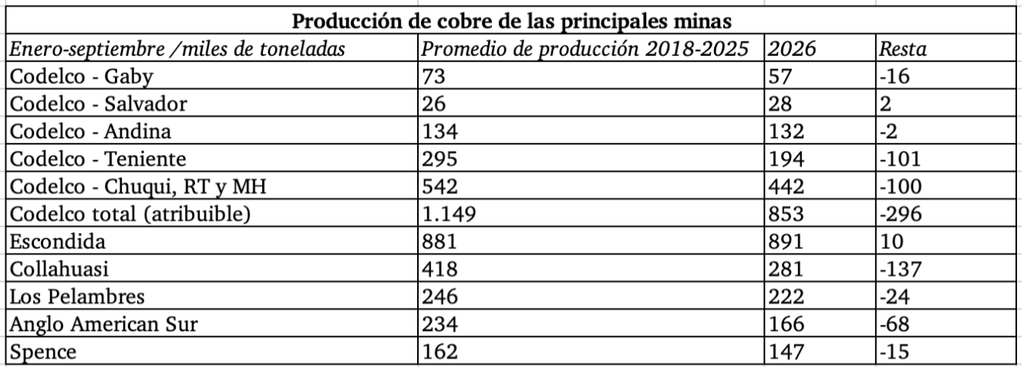
Taking a longer-term view to identify more reliably which major mining operations have experienced the largest declines, Codelco and Collahuasi top the list. Comparing average production by mine through September over the 2018–2025 period with the same period this year, Codelco’s attributable production shows a decline of 296,000 tonnes, while Collahuasi’s has fallen by 137,000 tonnes.
El Teniente shows a reduction of 101,000 tonnes, while the Chuquicamata, Radomiro Tomic and Ministro Hales divisions show a decline of 100,000 tonnes.
Source: La Tercera