

The market that Codelco and Glencore’s potential new smelter in Chile will reach.
The smelter announced by Codelco and Glencore, with an estimated investment of US$2 billion, would dethrone El Teniente’s Caletones smelter as the country’s largest. According to an expert, the initiative “is more of a strategic decision than a business venture.”
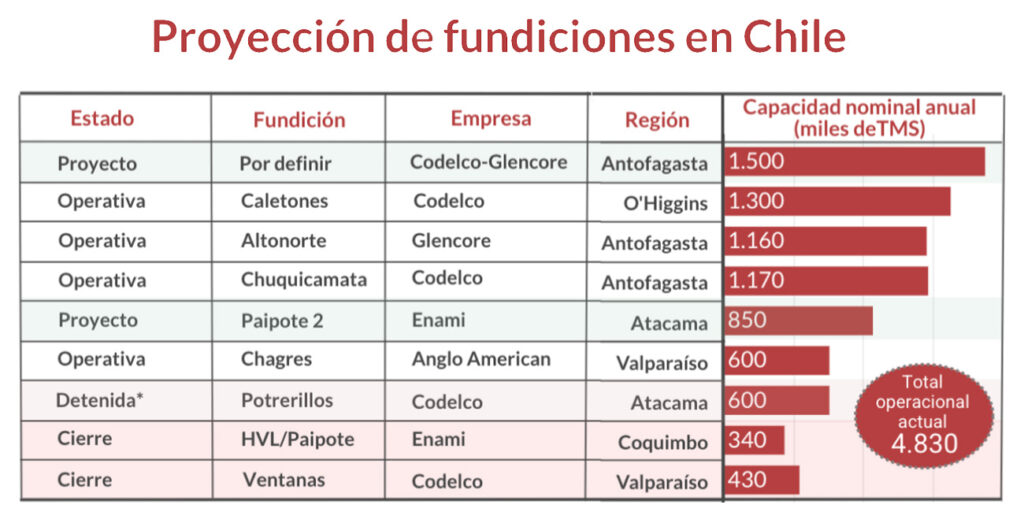
If materialized, and after more than 30 years without the construction of a new smelter in Chile, the plant announced by Codelco and Glencore would become the largest in the country. With a copper concentrate processing capacity of 1.5 million dry metric tonnes (DMT), it would surpass Codelco El Teniente’s Caletones smelter, which has a capacity of 1.3 million DMT.
Last Wednesday, the mining companies announced the new smelter through a Memorandum of Understanding (MoU), which—according to a source—considers an estimated investment of US$2 billion. Glencore will finance, build, operate, and maintain the smelter, while Codelco will supply 800,000 DMT to the plant over a ten-year period, renewable upon feasibility.
Fuente: Plusmining
Chile’s smelting market is currently supplied by five plants, ranked by nominal annual capacity: Caletones (Codelco El Teniente), Altonorte (Glencore), Chuquicamata (Codelco), Chagres (Anglo American), and Potrerillos (Codelco Salvador), according to Plusmining. Among these, Potrerillos is currently halted due to a chimney accident in July of this year.
“We are finalizing the engineering work to build the new chimney. This indicates that by the end of the first half of next year, we should complete construction and resume smelter operations in the second half,” said Codelco’s Vice President of Operations, Mauricio Barraza, during the company’s latest earnings call, referring to Potrerillos.
Notably, Altonorte is the newest smelter in Chile, as it was built in 1993 and is now more than 30 years old.
In addition to the five operating smelters, two facilities have ceased operations. Until May 2023, Codelco’s Ventanas smelter operated with a capacity of 430,000 DMT, but it has since been closed. This was followed by the shutdown of Enami’s Hernán Videla Lira smelter (Paipote) in February 2024.
The agreement to build the new smelter has been well received by the Ventanas union, which stated that the initiative “represents an important step toward resuming the industrialization of this strategic resource.”
Paipote, however, is in a different phase. Enami is currently moving forward with its modernization project, having already secured its Environmental Permit (RCA). The initiative—which involves an investment of US$1.7 billion—will nearly triple the smelter’s previous capacity and enable the capture of 99% of atmospheric emissions.
Enami is now in the process of selecting the offer that will finance the project. Although there is no fixed timeline, a source indicates that updates may be announced this week. Companies that submitted expressions of interest include Rio Tinto Mining and Exploration Limited, Sumitomo Mitsui Bank Limited NY Branch, and Mercuria Energy Trading S.A., among others.
Strategy More Than Business
“I believe the smelter is not arriving late,” says Juan Ignacio Guzmán, CEO of GEM, regarding the initiative announced by Codelco and Glencore. “The rationale is sound. This is ultimately a strategic decision rather than a commercial one. It will not be a highly profitable venture, but it can be strategically valuable in safeguarding against the risks associated with exporting concentrate and in producing cleaner copper with lower emissions,” he adds.
Glencore was selected by Codelco through a competitive process involving 14 global companies. The state-owned company chose the Swiss firm under a preferred off-take scheme, based on Glencore’s local and international smelting expertise.
Andrés González, head of mining at Plusmining, notes that “if materialized, the project would become the largest smelter in the country.” He adds that its capacity “would be nearly double that of Enami’s Paipote project. Although both projects are currently moving forward independently, one cannot rule out the possibility of an eventual agreement among Codelco, Glencore, and Enami to consolidate both into a single shared smelting facility.”
González adds that Chile currently has “an installed annual processing capacity of about 4.8 million DMT. In 2024, Chile produced around one million tonnes of smelter copper, equivalent to 23% of the country’s total copper concentrate production.”
Meanwhile, GEM’s CEO points out that, with the existing smelters in operation plus Potrerillos, “there is capacity to process five million tonnes of copper concentrate, which translates into 1.3 to 1.4 million tonnes of refined copper.”
“This essentially means that Chile produces between eight and nine million tonnes of concentrate annually, most of which is exported without being processed domestically,” he states.
Thus, Guzmán concludes that the capacity of the new smelter announced by Codelco and Glencore, alongside Enami’s Paipote project, “would cover only a relatively small fraction of all the concentrate produced in Chile. From a market standpoint, there is ample room to process significantly more concentrate within the country.”
Source: La Tercera