

The final days of Codelco’s chairman are unfolding amid audits, criticism over production, and concerns about safety.
Máximo Pacheco’s departure from the presidency of Codelco now has a date. On May 26, economist Bernardo Fontaine will take office, appointed by President José Antonio Kast to lead the state-owned company, which is currently facing scrutiny over production, safety, debt, and the execution of its structural projects.
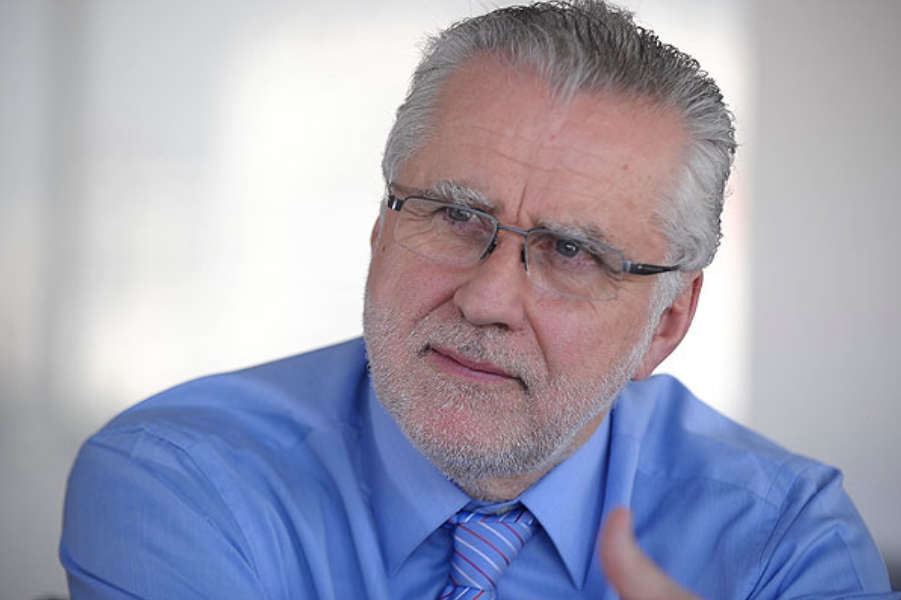
Source: EMOL, Máximo Pacheco, ex- presidency of Codelco.
The leadership transition comes amid a sustained public offensive by the Government and newly appointed board members, who have adopted a critical tone regarding the outgoing administration.
Fontaine’s first public remarks reflected the diagnosis currently shared by part of the economic establishment. “Codelco is carrying a lead backpack. We need to lighten it,” said the incoming chairman, pointing to the sharp increase in debt and the operational deterioration of the copper producer.
The Minister of Economy and Mining, Daniel Mas, also announced upcoming audits and investigations regarding the latest revelations about production and internal management.
The situation has become more complex due to a series of events that have hit the state- owned company over the past year: the controversy surrounding a possible overestimation of 20,000 tonnes of copper in December 2025, delays in structural projects, concerns over costs and safety, and the consequences of the accident at El Teniente that claimed the lives of six workers and remains under investigation by the Public Prosecutor’s Office.
However, the Pacheco administration also leaves behind milestones acknowledged even by its critics. The most significant is the partnership with SQM to develop the lithium business through NovaAndino Litio, a joint venture already operating in the Salar de Atacama and expected to contribute more than US$2.1 billion to the State this year. Codelco’s openness to partnerships with private companies is also viewed by experts as one of the most important strategic changes of the period.
Thus, the end of the Pacheco era leaves behind a mining company divided between progress in strategic alliances and operational deterioration, which today represents the main concern for the market, the Government, and the new administration set to take control of the world’s largest copper producer.
Fontaine Takes Over Codelco Amid Audits, Criticism, and a Focus on Regaining Control
This week, the Government officially confirmed Bernardo Fontaine’s appointment as chairman of Codelco’s board, a position he will formally assume on May 26 alongside new directors Luz Granier and Alejandro Canut de Bon.
Following his appointment, Fontaine delivered a harsh assessment of the state-owned miner’s financial and operational condition. “Codelco is carrying a lead backpack. We need to lighten it,” he stated.
The economist added that “Codelco’s problems can be summarized by the fact that over the last four years it delivered US$7 billion to the State, while increasing its debt by more than that amount. In other words, all of the contribution to the State was pure debt.”
He also stated that the company’s challenges include “dealing with rising costs, declining production, serious problems in structural investment projects, strengthening worker safety, safeguarding Codelco’s overall sustainability, and implementing, expanding, and deepening public-private partnerships.”
At the same time, Minister Daniel Mas toughened his stance toward the outgoing management and announced internal reviews. “We need to work seriously on safety, we need to work seriously on production so that it once again becomes the company it used to be — the company of all Chileans,” he told EmolTV.
Mas added that “we need to review what is happening with the new projects, the pace of implementation of those projects, and investments relative to their budgets. We definitely need to regain control of the company.”
Fontaine’s Previous Criticism of the State-Owned Company and Grau’s Response
Fontaine’s critical view of Codelco did not begin with his appointment. In recent years, the economist publicly questioned the mining company’s financial situation and its expansion into lithium.
“With the problems Codelco has and the inefficiency of its investments, it is a bad decision by the government to give it control over lithium exploitation,” he wrote two years ago on X.
He later also criticized the agreement with SQM: “Codelco negotiated at the worst possible time, when lithium prices had reached their peak. Codelco overpaid SQM.”
When Fontaine’s appointment became public yesterday, former Finance Minister Nicolás Grau posted on X: “It’s unbelievable that they would do something like this with Codelco.
There are highly capable people on the right who could have done a serious job worthy of leading the world’s largest copper producer.”
Evaluation of Pacheco’s Administration
Experts are divided in their assessment of Pacheco’s administration and point to the state- owned company’s structural problems.
Although there is broad consensus regarding the challenges currently facing Codelco, opinions on Máximo Pacheco’s administration are far from uniform among mining industry analysts.
Juan Carlos Guajardo, Executive Director of Plusmining, told Emol that “Máximo Pacheco’s administration, like any administration, has both positive and negative elements.”
Among the positive aspects, he highlighted “the acceleration of the company’s openness to agreements with third parties and private partners,” noting that this “opens — or accelerates — a path that will be fundamental for Codelco to find a way out of its current critical situation.”
However, he also raised concerns regarding the company’s internal management. “Máximo Pacheco assumed a role not only as chairman of the board, but also practically as the company’s manager or administrator,” he stated.
In his view, this created “a certain confusion of roles that was not positive,” adding that “placing so much emphasis on businesses outside copper” ultimately resulted in “investment and operational issues not being at the center of the company’s attention.”
Guajardo also linked recent controversies to management priorities. “The safety issues, the accidents that have occurred, and the uncertainty surrounding production also point to decision-making that may have been confusing or insufficiently clear and transparent,” he said.
For his part, former Codelco chairman Óscar Landarretche downplayed the idea that the company’s current problems stem exclusively from the latest administration.
“It is an extremely difficult company to manage, very challenging,” he said on Radio Pauta, adding that “in Codelco, it is very difficult to distinguish, among the problems it faces, how much responsibility belongs to the latest management and how much is due to structural issues.”
Landarretche pointed directly to the State’s historical reinvestment levels. “If you look at 30 or 40 years of Codelco, the owner’s reinvestment — meaning the State’s reinvestment in the company — is around 10% of profits. If you look at any mining company comparable in size to Codelco, it is 40%,” he stated.
Meanwhile, Juan Ignacio Guzmán, CEO of GEM Mining Consulting, asserted that “the administration of the latest board led by Máximo Pacheco falls significantly short internally in terms of safety, production, and costs.”
However, he added that “externally, regarding possible partnerships with SQM, Rio Tinto, Anglo American, and others, I believe progress was indeed made in the right direction.”
Production Under Pressure and Doubts Over Figures Marked the Last Year
Among the most delicate recent episodes for Codelco is the internal audit that detected a possible overestimation of nearly 20,000 tonnes of copper in December 2025.
According to preliminary findings published by Diario Financiero, part of the reported production may not have met the technical specifications required to be officially counted.
That month, the state-owned company reported 172,300 metric tonnes, well above the monthly average recorded during the rest of the year.
Concerns increased after Cochilco reported that production in March of this year fell to 91,000 tonnes, one of the lowest figures of the decade.
This was compounded by a warning from JP Morgan, which estimated that the company’s reported first-quarter production represented only around 20% of its annual target of 1.34 million tonnes.
According to the investment bank, the current pace would imply annualized production of around 1.1 million tonnes, more than 15% below the target committed for 2026.
The report also pointed to problems at El Teniente, where production is reportedly around 20% below expectations following the 2025 accident.
The Tense Shareholders’ Meeting and the Self-Criticism Demanded by Quiroz
Tensions between the Government and Pacheco’s administration became evident during Codelco’s latest shareholders’ meeting held in April.
During the meeting, Finance Minister Jorge Quiroz strongly criticized the absence of self-criticism in the company’s presentation.
“Is there no criticism at all? Does management have no criticism of itself whatsoever? Does the board fully share this self-congratulatory view?” Quiroz asked during the Q&A session.
The minister also expressed concern over the company’s performance. “Production over recent years fell by nearly 20% despite US$17 billion in investments,” he stated.
In response, Pacheco acknowledged mistakes in the company’s management. “Our excessive optimism (…) Many times we set certain goals for ourselves that are ambitious and important, but that do not fully account for the risks, difficulties, and adversities that must be faced in mining,” he said.
“It is not a good idea to be arrogant. We have been an overly successful company. We have learned to be humble,” he added.
The El Teniente Accident Continues to Impact the State-Owned Company
Another of the most complex issues left behind by the Pacheco administration is the investigation into the collapse at El Teniente that resulted in the deaths of six workers in July 2025.
The O’Higgins Regional Prosecutor’s Office carried out new inspections inside the mine to determine whether the concealment of information detected in Codelco offices — which led to the dismissal of three senior executives — played a role in the accident.
Prosecutor Aquiles Cubillos explained that “one of the theories being considered is that the Invariable Panel may have contributed to the interaction of cavities.”
He also stated that “Codelco conducted an audit and was able to verify that there were indeed two different reports and that information had been concealed from Sernageomin.”
The case has become one of the biggest criticisms of the state-owned company’s safety management and continues to be closely monitored by both the Government and the market.
NovaAndino, the Main Legacy Claimed by Pacheco
Despite the criticism, the partnership between Codelco and SQM to develop lithium operations in the Salar de Atacama stands out as one of the greatest milestones of the Pacheco administration.
The joint venture, NovaAndino Litio, formally began operations in December 2025 and is already projecting significant returns for the State.
“This has already started. It began on December 27 of last year,” Pacheco said on T13 Radio in April.
The executive added that “we currently have 2,500 workers at NovaAndino producing lithium. This year we are going to produce 270,000 tonnes of lithium.”
He also projected that NovaAndino will contribute “US$2.1 billion” to the State during this year.
Source: EMOL